Last updated on November 5, 2026
Backgammon is a great hobby for players of all skill levels, offering hours of entertainment with every session. However, if you’re just starting, the board and the rules might seem intimidating. Thankfully, backgammon is easy to understand after just a few games. The real challenge? Is winning. While learning the basics is important, nothing keeps the excitement alive quite like your first big win. Whether you’re playing socially, in a tournament or against an online opponent, the chance of winning makes the game far more enjoyable. Practice improves your skills over time. However, if you’re eager to start winning sooner rather than later, there are strategies that can help. Here are some key Deluxe Backgammon tips to boost your chances of winning.
What is backgammon?
Backgammon is a game of strategy and luck, played by either two individuals or two teams. With links to ancient games stretching back around 5,000 years, it’s one of the world’s oldest board games.
A game of backgammon is played on a board with 24 triangular markers, these are known as points. Each player starts with 15 checkers, which they move around the board based on the roll of two dice. The objective? Is to be the first to remove all your checkers from the board. This is a process called bearing off. To do this, players must first move their checkers into their home board (also called the inner board). Once all their pieces are there, they can start bearing off, rolling the dice to remove checkers one by one. The first to bear off all their checkers wins the game.
It might sound simple, but backgammon isn’t just about rolling dice and hoping for the best. Although luck plays a part, strategy is key. Players must decide whether to move aggressively, block their opponent, or play defensively. Every roll presents a new decision, making each game unique. One of the most exciting aspects of backgammon is the doubling cube. This special die, marked with the numbers 2, 4, 8, 16, 32, and 64, allows players to raise the stakes in the game. When a player offers a double, their opponent must either accept the challenge or forfeit the game. The doubling cube adds a layer of risk and strategy, making games more intense and rewarding.
Playing backgammon: the rules
While the basic rules are straightforward, mastering backgammon requires strategy and a solid understanding of key moves. Here’s a breakdown of how a typical game unfolds and the essential rules you need to know.
Starting the game
The backgammon board is set up as shown in the diagram below. Each player rolls a single die to decide who goes first. The player with the higher number starts and moves their checkers using the numbers from that initial roll. If both players roll the same number, they roll again.
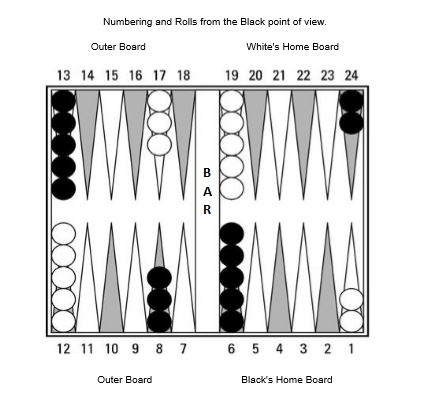
Moving the checkers
- Checkers can only be moved to open points, meaning spaces not occupied by two or more opposing checkers.
- If possible, both numbers rolled must be used. If only one number can be played, the player must move using the higher roll.
- If neither number can be used legally, the player loses their turn.
Hitting and entering from the bar
A point occupied by a single checker is called a blot. If an opponent lands on a blot, they hit it, sending that checker to the bar in the centre of the board.
- A checker on the bar must be re-entered into the opponent’s home board before making any other moves.
- The player rolls the dice and places the checker on an open point matching one of the rolled numbers.
- If both rolled points are occupied by two or more of the opponent’s checkers, the player loses their turn.
Bearing off: winning the game
Once a player has moved all of their checkers into their home board, they can start bearing off, removing checkers from the board.
- A checker can be removed by rolling a number that matches the point it occupies.
- If that exact number isn’t rolled, a checker from a higher-numbered point must be removed instead.
- If there are no checkers on higher-numbered points, the player can bear off from the highest occupied point.
How to win at backgammon
Once you know how to play backgammon, the next big question is: how do you win more often? Since the game involves rolling dice, luck plays a role. However, don’t be fooled. Strategy and tactics matter more than just luck. While you can’t control the dice, you can control how you play each roll. Every move shapes the game, and smart decisions can tip the odds in your favour. Here are some key strategies to help you win more often:
Learn the best opening moves
Backgammon is like many other games. Your first move can shape your chances of winning. The first player also has an advantage in backgammon. If you roll the highest number and get to go first, you have the whole board open, so it’s important to start strong. Since there are no blots at this stage, your focus should be on securing points and setting up a solid position.
Of course, luck plays a role too. Sometimes, the dice won’t give you the best opening move, no matter how well you plan. But when the roll is in your favour, you can use some of the top opening strategies to gain an early advantage. Here are two of the best:
Creating a Prime – If you roll a 3–1, 4–2, or 6–1, you can build a prime to block your opponent. A 3–1 roll is the strongest, as it lets you secure the 5-point, widely considered the best opening play.
The Lover’s Leap – This move requires a 6–5 opening roll and involves jumping a checker from your 24-point to your 13-point. It gives you a strong position on the ‘safe mid-point’, though it does leave your remaining checker on the 24-point exposed. Many players see it as a risk worth taking.
Knowing these key opening moves gives you the best chance of staying ahead from the start.
Strategies
You can’t remove risk from backgammon, but a solid strategy helps you manage it and play with confidence. There are plenty of strategies to learn, each offering different advantages. The more you practice, the better you’ll get, so testing them in software resources like XG Mobile Backgammon can be a great way to improve.
Here are the main strategies to keep in mind:
The Blitz: The Blitz is a strategy that focuses on aggressive play. It involves actively attacking your opponent’s vulnerable checkers rather than working to build points or run home. Hitting at every opportunity is the main objective of the blitz. This can slow your opponent’s game, though be wary that you may also end up leaving your checkers vulnerable to attack, without any real guarantee of success.
The Running Game – The simplest strategy in backgammon. You move your checkers home as fast as possible to start bearing off. If both players use the running game, it often comes down to luck and who rolls better.
Priming – We’ve covered priming as an opening move, but it’s useful throughout the game. Building at least four points in a row creates a barrier, slowing your opponent while giving you safe landing spots. You can also combine priming with blitzing in a ‘two-way forward attack’, a strategy that strengthens your position while making life harder for your opponent.
The Holding Game – In the holding game, instead of rushing home, you secure an anchor point on your opponent’s home board. This gives you a safe landing spot if you get knocked onto the bar while also threatening their checkers.
- The Back Game – The back game is similar to the holding game, but instead of securing a single point, you aim to hold multiple points in your opponent’s home board. This is useful if you keep getting sent to the bar, helping you turn a bad game around by disrupting your opponent’s moves.
Doubling
You can also use doubling strategically. The key is to offer a double when you’re neither too far ahead nor too far behind, increasing the chance your opponent accepts. If you follow this with a strong strategy, you could turn a close match into a convincing win.
Master these strategies, and you’ll have more control over every game, regardless of how the dice land.
Learn how to weaken your opponent
How aggressive or defensive you play is a personal choice, and going all-out on offence isn’t always the best path to victory. No matter your strategy, knowing how to disrupt your opponent’s game can give you an edge. Here are some of the best ways to do that:
Hold the 20-Point – Also known as the ‘golden anchor’, the 20-point is your opponent’s 5-point. Controlling it makes it harder for them to build an effective prime and gives you a safe place to land checkers from the bar. The key is knowing when to break this position to maximise its impact.
Hit your opponent’s blots – Whenever your opponent leaves a blot (a single checker on a point), consider taking the opportunity to hit it. This slows them down and makes it harder for them to move forward.
Block their moves – Placing two or more checkers on key points creates a strong defence. It stops your opponent from landing there, protects your own checkers, and limits their movement.
By using these tactics, you can disrupt your opponent’s strategy and put yourself in a stronger position to win at backgammon.
Related content
Backgammon Tips at Backgammon Galore.