Backgammon is all about strategy, positioning, and anticipating your opponent’s moves. One important concept to master is keeping your checkers “in range.” This means ensuring your checkers are close enough to support each other, so they can work together effectively. In this Deluxe Backgammon post, we talk about the importance of keeping your checkers in range and explore why this idea is so valuable.
Conditions where staying in range works best
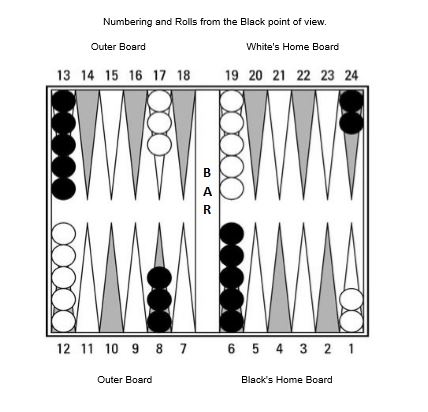
In backgammon, keeping your checkers in range means positioning your builders or attackers within 6 pips or fewer of a target blot or an open point you want to secure. Because you roll two six-sided dice, any distance from 1 to 6 can be hit or reached with a single die or a combination of two dice. Staying in range isn’t always the best tactic, but it is beneficial in these conditions:
Undeveloped positions
In backgammon, an undeveloped position is where a player’s checkers are still largely stuck in their starting configuration or haven’t progressed into a flexible formation. When your position is undeveloped, you lack flexibility. If you roll numbers that don’t allow you to safely move your back checkers, you are forced to dismantle your existing points or stack checkers awkwardly. At the start of the game, when no clear threats have emerged, keeping checkers in range helps create flexibility on subsequent rolls. Moving checkers, particularly as blots, is worthwhile and low risk.
Recirculated checkers
In backgammon, recirculated checkers occur when both players have pieces hit and sent to the bar. When they re-enter, the focus often shifts to the outer boards. As a result, players must maintain connectivity by keeping their checkers close together. This tight formation protects individual checkers from being hit again and allows them to safely form secure points.
Low threat environments
A “low-threat environment” describes a board state where you can make strategic decisions without immediate consequences from your opponent. In generally means you do not have exposed checkers within immediate hitting range (usually within 1 to 6 pips). Additionally, your opponent has few active builders or ammunition to launch an attack, or their home board is weak and open. If neither side is running a blitz or aggressively attacking, maintaining range becomes a solid strategy for managing the board.
These situations give you the breathing room to focus on positioning without worrying about immediate threats.
What does staying in range achieve?
When your checkers are in range, you gain several advantages. Here’s why this tactic can turn the tide in your favour:
Mutual support
Checkers that are close together can back each other up. This makes it harder for your opponent to hit lone checkers, giving you more stability on the board.
Smooth coordination
Keeping checkers in range allows them to work together like a well-oiled machine. This makes it easier to build primes, block your opponent, or escape from tough spots.
Territorial control
By staying in range, you can control specific areas of the board. Whether it’s the outfield or a quadrant, your checkers become a united front that’s tough to crack.
Disrupting your opponent
Strategic positioning can force your opponent into less desirable moves. For example, they might have to send their checkers to points where they’re less effective, weakening their overall position.
Forcing risky moves
When your checkers are well-placed, your opponent may have no choice but to take risks they’d rather avoid. This puts you in control of the game’s flow.
When staying in range looks… odd
Sometimes, moves to keep your checkers in range can look strange or even counterintuitive. These “mystery” moves might not seem to make sense at first glance. However, they’re often the result of a deeper understanding of positioning. Think of your checkers as islands connected by a chain of allies. That chain may seem thin or fragile, but it creates a strong network that supports your overall strategy. Good players often make these moves instinctively, relying on their experience and feel for the game.
Why this concept can feel abstract
It’s true, keeping checkers in range can sometimes feel like an abstract or philosophical idea. However, at its core, it’s a practical strategy that helps you maintain control and flexibility. The key is to recognise when this tactic fits the game’s flow and when it’s better to shift gears.
How to practice staying in range
Like any backgammon strategy, practice makes perfect. Here are some tips to get comfortable with the idea:
Watch better players
Observe how experienced players position their checkers. Pay attention to when they prioritise staying in range and how it affects the game.
Experiment with moves
During casual games, try making moves specifically to keep your checkers close. Even if it feels unnatural, you’ll start to see the benefits over time.
Review your games
Look back at games where your positioning worked well and where it didn’t. Analyse how keeping your checkers in range (or failing to) influenced the outcome.
Focus on key quadrants
Choose one area of the board to dominate. Use your checkers’ range to control that space and limit your opponent’s options.
Summary
Staying in range is one of those backgammon strategies that feels simple on the surface but reveals its depth the more you use it. By keeping your checkers close, you create a foundation of support, coordination, and control that can adapt to almost any game scenario. It may take time to recognise when this approach is most effective, but once you do, you’ll start to see the board differently. You’ll spot opportunities to build stronger positions, force your opponent into tough spots, and gain the upper hand more often.
So, the next time you roll the dice, think about your checkers like a team. Keep them in range, and you’ll give yourself the edge you need to outmanoeuvre your opponent and win the game. Ready to test it out?
Related content
Direct range at Backgammon Galore.